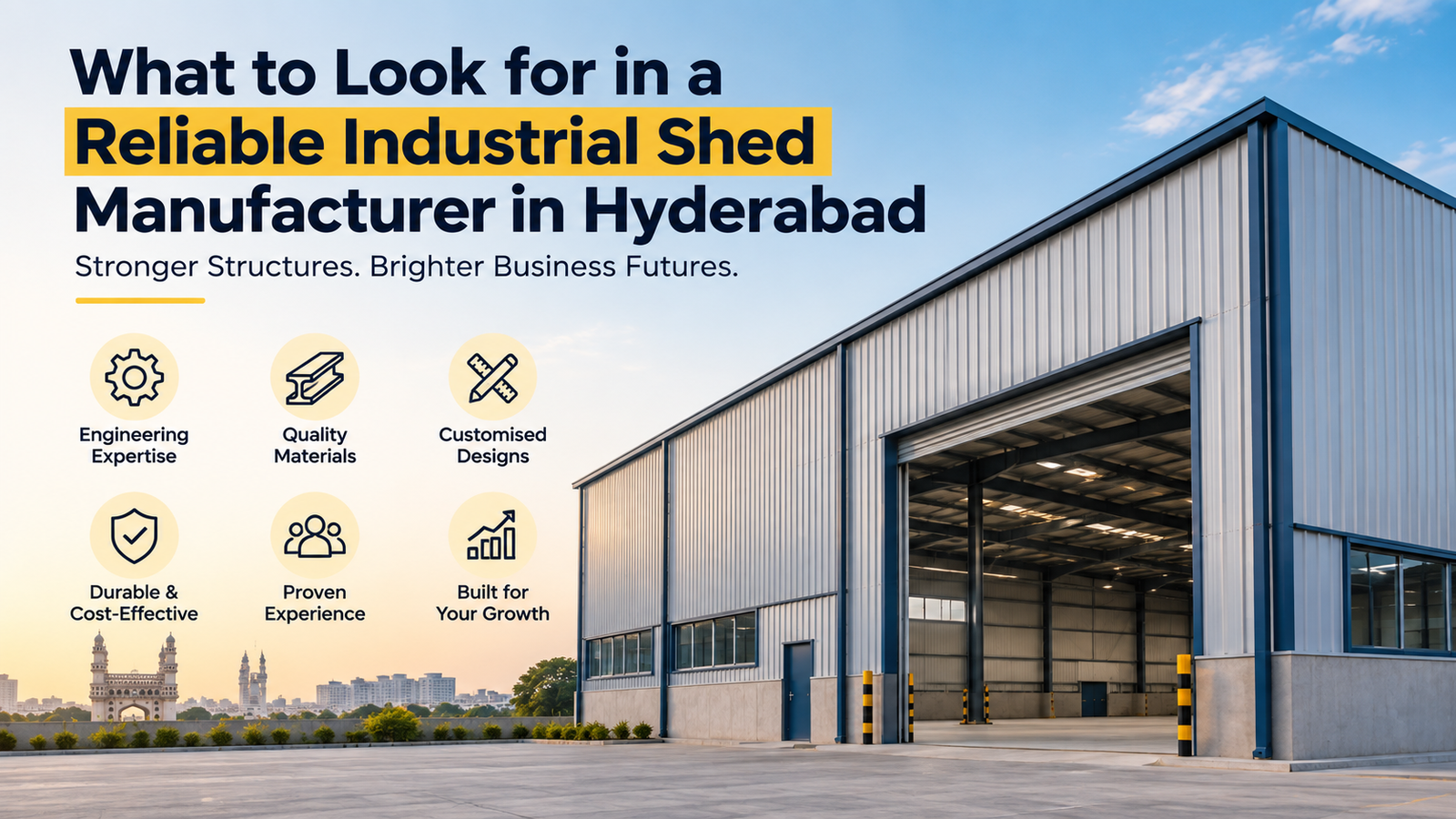
Industrial development in Hyderabad is growing steadily across sectors such as manufacturing, logistics, pharmaceuticals, food processing, engineering, retail distribution and warehousing. As businesses expand, the demand for durable, spacious and cost-effective industrial buildings is also increasing.
Industrial sheds are widely used for factories, warehouses, workshops, production units, storage facilities and commercial operations. However, the quality and long-term performance of an industrial shed depend heavily on the company that designs, manufactures and installs it.
Choosing the right Industrial Shed Manufacturer in Hyderabad is therefore an important business decision. A reliable manufacturer should provide more than steel components. The company should understand structural engineering, material quality, project planning, fabrication, installation and future expansion requirements.
This guide explains the most important factors businesses should consider before selecting an industrial shed manufacturing company.
What Is an Industrial Shed?
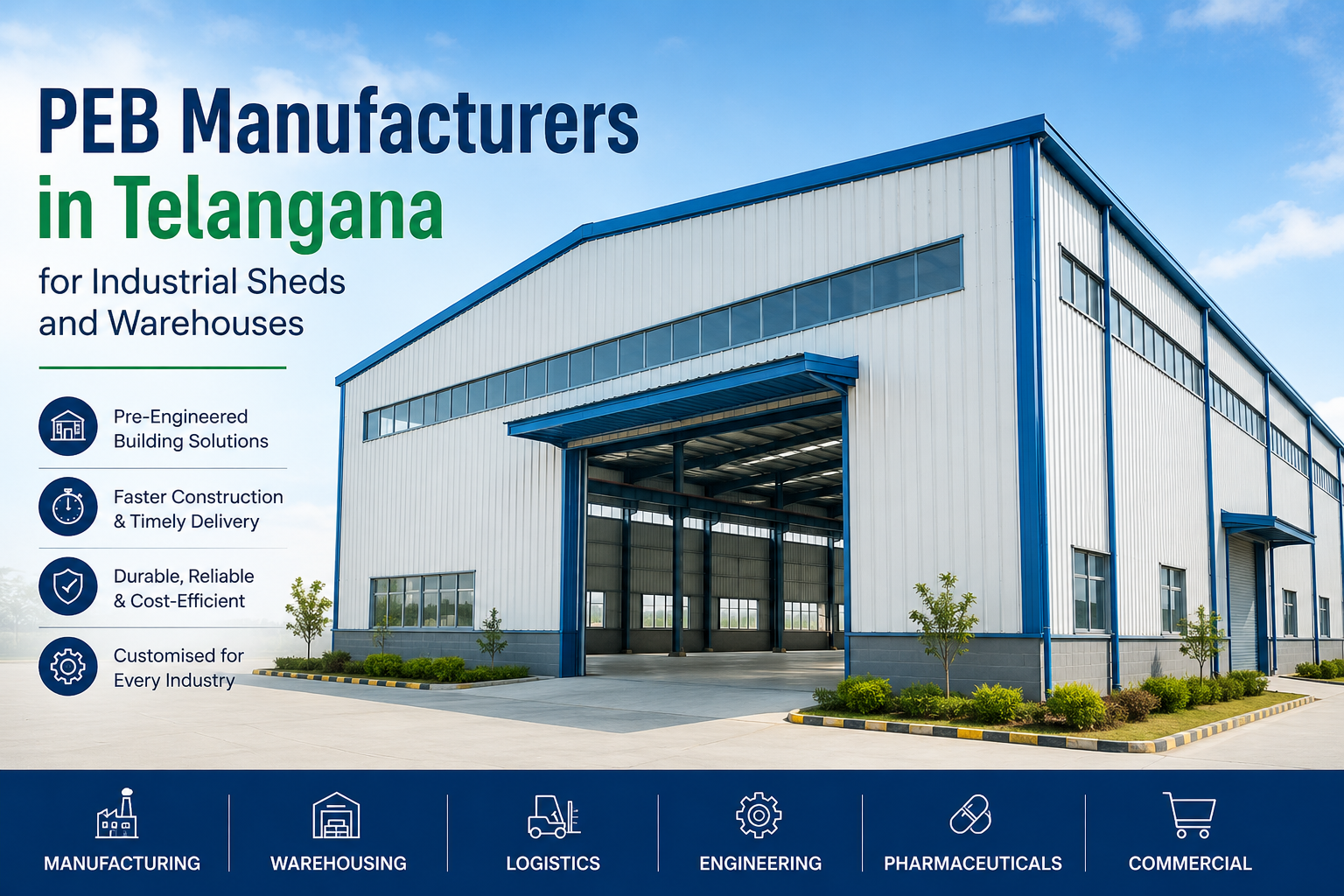
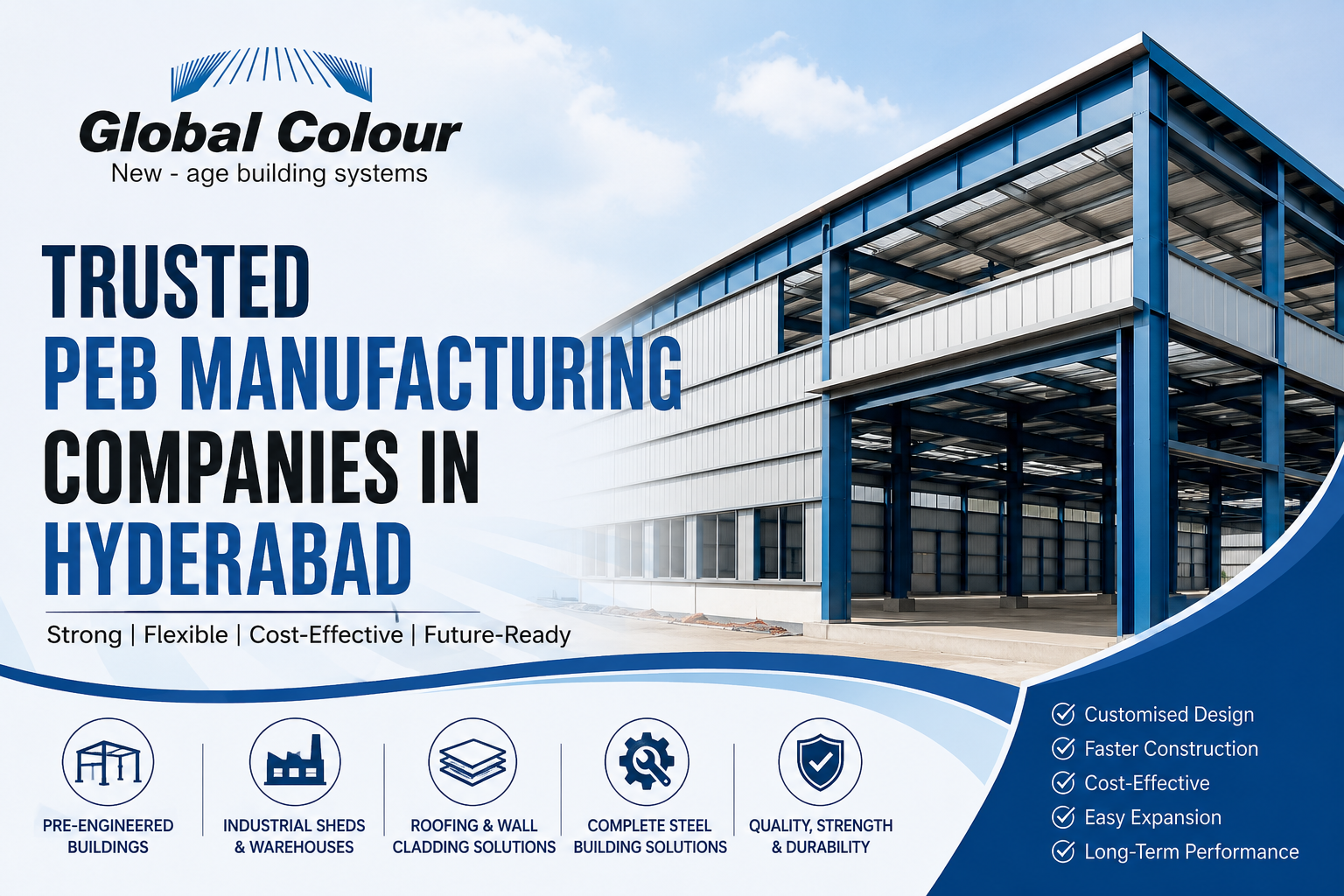
An industrial shed is a steel building designed for manufacturing, storage, processing, repair, assembly or other commercial activities.
Modern industrial sheds are commonly constructed using pre-engineered building systems. In this method, the structural components are designed and manufactured in a controlled facility before being transported to the project site for installation.
A typical industrial shed may include:
- Primary steel frames
- Columns and rafters
- C and Z purlins
- Roofing sheets
- Wall-cladding sheets
- Bracing systems
- Fasteners and structural accessories
- Ventilators and skylights
- Doors and windows
- Mezzanine floors
- Crane-supporting systems
- Gutters, flashings and trims
The design of the shed depends on its intended use, building dimensions, machinery layout, site conditions and operational requirements.
Why Choosing the Right Manufacturer Matters
An industrial shed is not a temporary structure. It becomes an important part of a company’s operations and supports machinery, workers, raw materials, production and storage.
Poor structural planning or low-quality fabrication can lead to problems such as:
- Construction delays
- Material wastage
- Water leakage
- Improper ventilation
- Weak roofing systems
- Misaligned structural components
- Difficult maintenance
- Limited expansion options
- Increased long-term costs
A professional Industrial Shed Manufacturer in Hyderabad studies the project carefully and develops a solution based on the client’s actual requirements.
The right manufacturer helps ensure that the structure is strong, functional, safe and suitable for future business growth.
1. Technical and Structural Engineering Expertise
The first factor to evaluate is the manufacturer’s technical capability.
Industrial sheds must be designed after considering different structural loads and site conditions. The design should not be based only on the length and width of the building.
Engineers may need to consider:
- Dead loads
- Live loads
- Wind loads
- Roof loads
- Equipment loads
- Crane loads
- Building height
- Column spacing
- Seismic conditions
- Local environmental conditions
- Future expansion plans
A dependable manufacturer should have an experienced engineering team capable of creating a safe and efficient structural design.
Proper engineering also helps reduce unnecessary steel consumption while maintaining the required strength and performance.
2. Experience in Industrial Shed Projects
Experience is another important factor when selecting an industrial shed company.
A manufacturer with experience across different industries is more likely to understand practical requirements such as:
- Machinery placement
- Vehicle movement
- Material handling
- Production flow
- Storage capacity
- Loading and unloading
- Crane operations
- Ventilation
- Natural lighting
- Employee movement
- Safety access
Businesses should ask whether the manufacturer has completed projects such as factories, warehouses, workshops, logistics centres or production units.
Relevant experience helps the company identify potential challenges during the planning stage rather than after construction begins.
3. Customised Design Capabilities
Every industrial project is different. A warehouse does not have the same requirements as a manufacturing plant, and a fabrication workshop may need a completely different layout.
A reliable Industrial Shed Manufacturer in Hyderabad should provide customised designs rather than offering the same standard structure for every project.
Customisation may include:
- Building length and width
- Eave height
- Roof slope
- Bay spacing
- Clear-span design
- Crane-supporting structure
- Mezzanine floors
- Machinery zones
- Loading bays
- Office areas
- Ventilation systems
- Skylights
- Entry and exit points
- Roofing and cladding options
The manufacturer should understand how the building will be used before preparing the final design.
4. Quality of Steel and Building Materials
The quality of the structure depends greatly on the materials used.
Businesses should clearly understand the proposed specifications for:
- Structural steel
- Primary frames
- Secondary members
- Roofing sheets
- Wall cladding
- C and Z purlins
- Fasteners
- Protective coatings
- Welding materials
- Insulation panels
Low-quality materials may reduce the durability of the building and increase maintenance requirements.
A professional manufacturer should explain the material grades, thicknesses, coatings and expected performance before finalising the project.
Clients should not select a company only because it offers the lowest quotation. A lower initial price may result from reduced material quality, thinner components or an incomplete project scope.
5. In-House Manufacturing Facilities
A company with organised manufacturing capabilities can maintain better control over production quality and timelines.
A typical manufacturing process may include:
- Material inspection
- Cutting
- Welding
- Drilling
- Bending
- Roll forming
- Surface preparation
- Painting or coating
- Dimensional inspection
- Component marking
- Packing and dispatch
Controlled manufacturing improves accuracy and reduces excessive on-site fabrication.
Before selecting a manufacturer, businesses should understand whether the company manufactures the main components directly or depends entirely on third-party vendors.
Strong manufacturing capabilities can improve consistency, quality control and project coordination.
6. Quality-Control Process
Quality checks should be performed at multiple stages of the project.
A reliable manufacturer should inspect:
- Raw materials
- Welding quality
- Structural dimensions
- Hole alignment
- Surface finishing
- Protective coating
- Roofing sheets
- Purlins and secondary members
- Fasteners and accessories
- Final component identification
Quality control reduces the risk of incorrect components reaching the construction site.
It also helps ensure that different parts fit correctly during erection, which supports faster and safer installation.
7. Complete Project Scope
Industrial shed quotations can differ significantly because every company may include a different scope of work.
Before comparing prices, businesses should check whether the quotation includes:
- Structural design
- Fabrication
- Roofing
- Wall cladding
- Purlins
- Fasteners
- Transportation
- Erection
- Crane arrangements
- Ventilation systems
- Skylights
- Gutters and downpipes
- Doors and shutters
- Project supervision
- Safety equipment
- Civil foundation work
A quotation that appears inexpensive may exclude essential items.
The company should clearly explain what is included, what is excluded and what will be charged separately.
8. Project Planning and Timely Execution
Industrial projects are usually connected to business operations. Delays may affect machinery installation, production schedules, inventory planning and revenue.
A reliable Industrial Shed Manufacturer in Hyderabad should provide a clear project plan covering:
- Design approval
- Material procurement
- Manufacturing
- Quality checks
- Transportation
- Site preparation
- Structural erection
- Roofing and cladding
- Final inspection
- Project handover
The manufacturer should also communicate possible risks that may affect the timeline, such as site access, weather, delayed approvals or foundation readiness.
Proper coordination between the factory team and the site team is essential for timely execution.
9. Installation and Erection Expertise
High-quality fabrication alone is not enough. The structure must also be installed correctly.
Industrial shed erection involves:
- Lifting steel components
- Aligning columns
- Installing rafters
- Fixing purlins
- Adding bracing systems
- Installing roofing sheets
- Fixing wall cladding
- Sealing joints
- Installing gutters and accessories
- Checking structural alignment
Experienced erection teams follow organised procedures and safety practices.
Poor installation may cause alignment issues, roof leakage, structural instability or unnecessary delays. Businesses should therefore confirm that the manufacturer provides trained installation teams and proper site supervision.
10. Safety Standards
Safety is an important part of both construction and long-term building performance.
During installation, workers may operate at significant heights and use heavy machinery. The company should follow appropriate safety procedures, including:
- Personal protective equipment
- Safe lifting practices
- Scaffolding and access systems
- Fall-protection measures
- Site barricading
- Equipment inspection
- Supervised erection
- Emergency planning
The structural design should also account for operational safety after the building is completed.
Businesses should prefer manufacturers that treat safety as a core project responsibility rather than an optional requirement.
11. Roofing and Cladding Options
The roof and wall systems affect the appearance, temperature, ventilation and durability of an industrial shed.
Common options include:
- Colour-coated roofing sheets
- Galvanised roofing sheets
- Insulated roofing panels
- Wall-cladding sheets
- Skylight panels
- Ridge ventilators
- Louvers
- Flashings
- Gutters and downpipes
- Heat-resistant roofing systems
The right choice depends on the building’s purpose.
For example, a warehouse may need natural lighting and ventilation, while a temperature-sensitive facility may require insulated roofing and wall systems.
A professional manufacturer should recommend suitable options based on operational requirements and budget.
12. Future Expansion Possibilities
Business requirements can change over time.
A factory may need additional production space, while a warehouse may require more storage capacity. Planning for future expansion during the initial design stage can reduce the difficulty and cost of later modifications.
Possible expansion options include:
- Extending the building length
- Adding extra bays
- Increasing storage areas
- Adding mezzanine floors
- Creating new production sections
- Expanding loading areas
- Adding office or utility spaces
A knowledgeable Industrial Shed Manufacturer in Hyderabad should discuss expansion possibilities before finalising the structural design.
13. Energy-Efficient Features
Industrial buildings consume energy for lighting, cooling and ventilation. Proper design can help reduce long-term operating costs.
Energy-efficient features may include:
- Skylights for natural daylight
- Ridge ventilators
- Louvers
- Insulated roofing sheets
- Heat-reflective coatings
- Wall insulation
- Solar panel provisions
- Rainwater harvesting systems
- Natural airflow planning
These features should be selected based on the internal activity, local climate and operating schedule of the facility.
Energy-efficient design can improve workplace comfort and reduce dependence on artificial lighting and mechanical ventilation.
14. Client Support and Communication
Clear communication is essential throughout an industrial construction project.
The manufacturer should provide regular updates regarding:
- Design approvals
- Material procurement
- Production status
- Dispatch schedules
- Site readiness
- Installation progress
- Technical changes
- Completion timelines
The client should also have a dedicated point of contact for project-related discussions.
Poor communication can lead to misunderstandings, design changes and delays. A professional company maintains transparency from the initial consultation to final project handover.
15. Post-Installation Support
A manufacturer’s responsibility should not always end immediately after installation.
Post-installation support may include:
- Final structural inspection
- Roof leakage checks
- Fastener inspection
- Alignment verification
- Maintenance guidance
- Repair support
- Expansion consultation
- Replacement of accessories
- Technical documentation
Businesses should ask what type of support is available after project completion.
Reliable after-sales support helps maintain the performance and durability of the industrial shed.
Applications of Industrial Sheds
Industrial sheds can be designed for a wide range of business applications.
Manufacturing Units
Manufacturing sheds provide space for production lines, machinery, raw materials, workers and finished goods.
Warehouses
Warehouse sheds support storage racks, forklifts, loading bays, packaging areas and dispatch operations.
Workshops
Industrial sheds are suitable for automobile workshops, fabrication units, repair centres and maintenance facilities.
Logistics Centres
Logistics companies use industrial sheds for sorting, storage, packaging and distribution.
Food Processing Units
Food processing sheds can be planned with suitable layouts, ventilation and insulation based on operational requirements.
Pharmaceutical Storage Facilities
Industrial sheds may support pharmaceutical warehouses, packaging areas and selected utility buildings.
Agricultural Storage
Steel sheds can be used for storing grains, equipment, seeds, fertilisers and other agricultural materials.
Commercial Storage Buildings
Retailers, distributors and e-commerce companies use industrial sheds for inventory and fulfilment operations.
Questions to Ask Before Finalising a Manufacturer
Before signing an agreement, ask the manufacturer the following questions:
- Do you provide structural design and engineering?
- What material specifications are included?
- Do you have in-house manufacturing facilities?
- Does the quotation include transportation and installation?
- What is the estimated project timeline?
- Can the building support future expansion?
- What roofing and cladding options are available?
- Do you provide crane-compatible shed designs?
- What quality checks are followed?
- What support is available after installation?
Clear answers to these questions help businesses compare manufacturers more effectively.
Why Choose Global Colour Steels?
Global Colour Steels provides customised steel building solutions for industrial and commercial requirements.
Its major services and products include:
- Pre-engineered buildings
- Industrial sheds
- Warehouse buildings
- Factory structures
- Multi-storey steel buildings
- Colour-coated roofing sheets
- Deck sheets
- C and Z purlins
- Custom steel structures
The company focuses on understanding the client’s building purpose, dimensions, operational layout and expansion requirements before recommending a suitable solution.
Global Colour Steels supports different stages of the project, including structural planning, manufacturing, supply and installation.
Businesses looking for an experienced Industrial Shed Manufacturer in Hyderabad can consider Global Colour Steels for customised and dependable steel building solutions.
Frequently Asked Questions
What is the cost of an industrial shed in Hyderabad?
The cost depends on the shed dimensions, steel quantity, roof design, building height, material specifications, crane requirements, cladding, transportation and installation scope.
How long does industrial shed construction take?
The timeline depends on the project size, design complexity, material availability, site readiness and installation conditions. Pre-engineered sheds generally support faster execution because major components are manufactured in advance.
Can an industrial shed be customised?
Yes. The building dimensions, height, roof design, crane system, mezzanine floor, ventilation, doors, loading bays and cladding can be customised.
Are industrial sheds suitable for warehouses?
Yes. Industrial sheds are commonly used for warehouses because they provide wide storage spaces, sufficient height and flexible internal layouts.
Can solar panels be installed on an industrial shed?
Solar panel provisions can be considered during structural design. The roof and building must be engineered for the additional load and installation requirements.
How do I select the best Industrial Shed Manufacturer in Hyderabad?
Review the company’s engineering expertise, project experience, material quality, manufacturing facilities, installation support, safety standards, project scope and after-sales service.
Conclusion
Choosing the right industrial shed manufacturer requires careful evaluation. Businesses should look beyond the initial quotation and consider structural engineering, material quality, customisation, manufacturing capabilities, installation experience and long-term support.
A reliable Industrial Shed Manufacturer in Hyderabad should understand the client’s business operations and create a structure that supports productivity, safety and future expansion.
Industrial sheds are long-term business assets. The right manufacturer helps ensure that the building remains durable, functional and suitable for changing operational needs.
Global Colour Steels provides customised industrial shed, warehouse and pre-engineered steel building solutions for businesses across Hyderabad and surrounding regions.
Contact Global Colour Steels
Phone: +91 99490 37716
Email: info@globalcoloursteels.com
Website: www.globalcoloursteels.com